
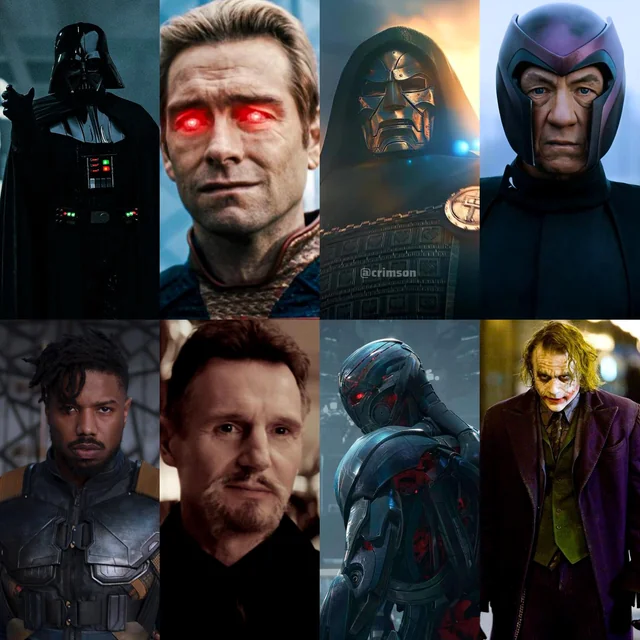
Like so many arguments this started on Reddit1. The leading question of which villain (pic below) had and evil plan and convinced people – all other than Homelander, arguably Vader (feared and to a few respected but followed Palpatine). All that really requires is a direction and a generous amount of riz for needy people to follow.
There was a slightly different question in the body:
Which villain do you think had the strongest justification for their actions?
That can be answered in a number of ways, such as qualifying either a moral or intellectual justification. However I think that the inevitable character backstory brings these even closer together. Inevitably, Thanos was also brought up (pardon the pun), and Doom I’ll assume we are not talking 616 Dr Doom as that’s a deep dive, into a can, with worms all the way down).
For nearly all of them, there is a leveller as most actions operated out of trauma fuelled belief, with a lot of plans effectively running interference to any justification of what they were attempting through a very narrow and context specific ideology. Thanos’ idea for erasing of half of life in the universe was an unsupported belief, and deeper in the comics is due to his stan for Death herself. Arguing for Ultron quickly becomes a case of Blue Orange morality2
Erik is as as close as we’ll get to a cogent vision but it’s still shaky. I’m of the opinion that the reason Erik’s ethos will always be limited with respect to Charles because he is operating from an isolationist framework, always framing this from a position of conflict. On the other hand Charles is typically scene as coming from a positional of mutuality. If nothing else Charles Xavier’s vision is a longer term strategy with higher growth potential.
It’s a somewhat naïve framing considering that both parties have separately compromised on their values to extraordinary degrees (thank you 1990). I think the differing scope of their vision is why each is compromised when separated. Separately Erik is an aggressive bully, and Charles is a manipulative pacifist. Erik’s stance is immediate and short term – he is a wartime governor concerned with the survival of his people in the current context. It leads him to make decisions that override his ethics. Charles has clear vision with a longer view of collaboration, and ecosystem building, but compromises on his morals to achieve it. ShaVash gives a nice summary on YouTube3. It brings up interesting topics like integration over assimilation and Nietzsche’s master-slave morality.
Movie and comic book villains are vehicles for story, and as such they lack depth for their nefarious plans to pass validation. Trauma driven belief is an interesting driver of plot and all we need to get to “I would have gotten away with it if it wasn’t for you middling kids” and “I’ll get you next time Gadget!”. That is probably why one of my favourite comics is Strong Female Protagonist, a dramatic superhero webcomic series written by Brennan Lee Mulligan and drawn by Lee Knox Ostertag4. It navigates through the complex path between our circumstance and how we piece that together to make decisions through the lens of superfolk5.
But as I reveal my identity as Captain Obvious, I am struck by how often our own Vision and Values are compromised by a lack of connection to our strategy, or our strategy to our plans and execution. This is important in strategy and planning for business and in our personal lives. How often in our day-to-day do our personal values come in conflict with the ethical frameworks we operate in? Health care, justice reform, a seat on the bus – is the disparity between our morals and ethics or the interpretation and execution of ethics in the strategy and plans – or are our strategies and plans addressing pragmatic needs and shortcutting around our vision and values?
Rather than get into a debate on whether personal or professional ethics exist (that’s a yeah-nah from me), I’ll leave with a desire to connect through ethics, strategy, planning and execution in work and personal frameworks, and to have ethically informed vision and infrastructure to wrap the whole. Having values and principles informing our vision and people and culture through our infrastructure should inform both top-down and bottom-up processes.
References
- LevelSquareFFG7117 “Who had the most morally questionable evil plan, but genuinely convinced people that they were doing the right thing?” Reddit r/superheroes (2026) ↩︎
- “Blue and Orange Morality” TV Tropes ↩︎
- “Professor X vs Magneto – Who Actually Wins?” ShaVash (2026) YouTube ↩︎
- “Strong Female Protagonist” Wikipedia ↩︎
- B.L. Mulligan & L.K. Ostertag “Strong Female Protagonist” (2012-2018) official website ↩︎

