
Hi folks,
Trust is a fundamental in any relationship, but dealing with a trust issue can seem like a fuzzy nightmare with more finger pointing that a carpark full of spider-men [ref] That’s one of the reasons I love the Trust Triangle framework from Anne Morriss and Francis Frei via Harvard Business School.
I’ve been collaborating with an entrepreneur, arts worker and business student on their project to build a accessibility app, aimed connecting people with lived experience with business to make change. This week we were looking at bridging communication gaps and building stake holder trust, so of course the “Trust Triangle” was a feature.
Anne and Frances have strong credentials in business leadership at all levels, and have an excellent podcast called Fixable. In their last book – “Move Fast and Fix Things” iv, they introduced the the Trust Triangle system for solving any relationship dilemma. It was built on their popular article “Begin with Trust” in Harvard Business Review May 2020
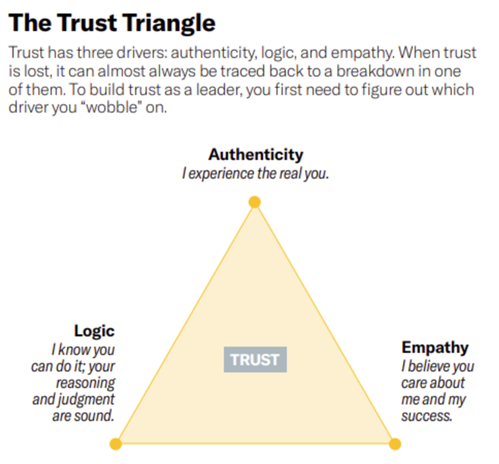
Trust has three drivers: authenticity, logic, and empathy. When trust is lost, it can almost always be traced back to a breakdown in one of them. To build trust as a leader, you first need to figure out which driver you “wobble” on.
Everyone has a go-to strength (which they call an anchor) and an area that’s less of a reflex, which may produce the wobble. The terms and framework are used to reduce the natural defensiveness that occurs when talking about trust.
It’s important to remember that trust is a perception of the receiver. If someone has a doubt about your logic, it’s not questioning that your logic is flawed; the focus is that they not receiving that part of the message yet.
The other thing about it is trust is in the eye of the beholder. This is a really lovely technique, that it’s not that I think I’m logical, for example, it’s do you experience me as logical? It’s not that I think I’m empathetic, it’s do you experience me as empathetic? vi
Looking at relationships with a trust lens allows us to make this intangible quality something we can build and nurture, without it being a character flaw in either party. It’s about speaking the right language and looking at the needs of the person you are communicating with. If a person is thirsty and you bring them a bran muffin, they might be frustrated. Similarly, if we respond to a need for empathy might with logic then we might not be bridging the gap.
Frances Frei’s TED talk on Trust viii is a good audio starter, as is their podcast episode on Uber ix where it all started. For applying the framework a good episode to listen to “How to get your confidence back”. Transcript vii and Podcast-ep on Spotify x. There is also the episode on How to help your team build trust vi
Empathy is a big topic in neurodivergent discussion, and starting with the framework that an issue the mutual gap between individuals is refreshing. The communication barrier between autistic people and Double Empathy communications barrier. It might be helpful in our context to note that neurodiversity has been covered on their podcast a number of times and Francis has been clear on her autistic identity.
Have a wonderful week
Trust Triangle Graphic and text
Visual description: a yellow triangle with it’s points labelled Authenticity, Logic and Empathy. Text in the graphic reads
The Trust Triangle
Trust has three drivers: authenticity, logic, and empathy. When trust is lost, it can almost always be traced back to a breakdown in one
of them. To build trust as a leader, you first need to figure out which driver you “wobble” on.Authenticity
I experience the real you.Logic
I know you can do it; your reasoning and judgment are sound.Empathy
I believe you care about me and my success.
References
- iv Morris. A & Frei F How to Move Fast and Fix Things. HBR Press (2024)
- v Morriss, M. & Frei, F “Begin with Trust” HBR (May, 2020)
- vi Moriss, M. & Frei, F. ”How to help your team build trust” Fixable (Feb, 2024)
- vii Morris, M. & Frei, F. ”How to get your confidence back” Fixable (Feb, 2024)
- viii Frei, F ”How to build (and rebuild) trust” TED (May, 2018)
- ix Morris, M. & Frei, F. ”Uber, and how to fix things when trust is broken” Fixable (Aug, 2023)
- x Morris, M. & Frei, F. ”How to help your team build trust” Spotify Link – Fixable (Feb, 2024)

