Independence v Autonomy – Autistic health and welfare outcomes

This! This right here!

Ella makes the valid point on the language used when talking about autistic life goals. This common term is living “independently” – however living without dependencies is rarely – if at all – possible in contemporary society. It’s certainly no possible if you are disabled in the society you are in. All people in societies have dependencies on a variety of services and supports. Independent living pushes the goals of others, often one of resource management, while failing to address that contemporary society is set up with a system of dependencies to keep going. When a person has needs outside or in addition to that of the established societal structure then living “Independently” is campaigned. The goal for the person of need however is to live autonomously – with a measure of self governance and agency.

The only additional thing I would add (and I believe is inferred) is if societally constructed obstacles (& supports) were equivalent for autistic and allistic people, we would see a reduction in quality of life gap, including employment, pay, mental health outcomes and life expectancy.

Insights from the 2024 Global Workplace Report

The XYZ of Work-Related Stress: 

Commentary on Gallup 2024 State of the Global Workplace report

Hi folks,

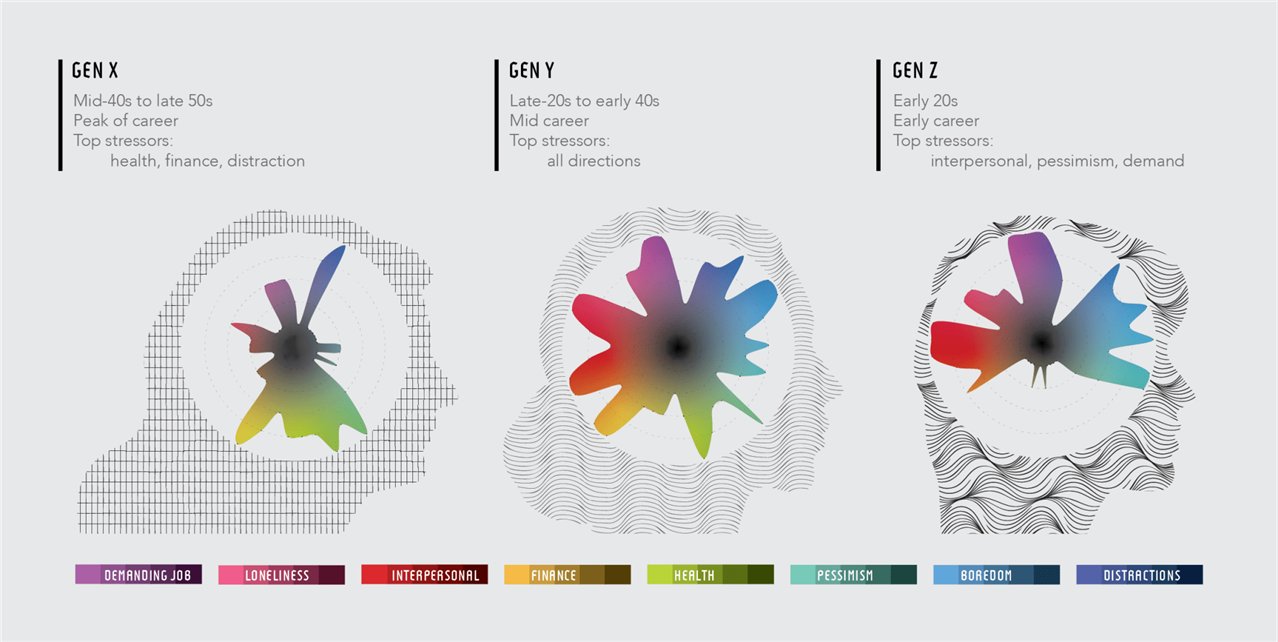
I was reading this week’s “Nightingale” – Data Visualisation Society eNewsletter (named after Florence, Nurse-Statistician-Legend) and there was an interesting article breaking down the 2024 State of the Global Workplace report by Gallup.  The report was arguing that people’s mental well-being has deteriorated in the past ten years (I’m finally trendy! Yay!). 

However, in her article “the XYZ of Work-Related Stress”, author Shanfan Huang, makes a great point that different generations have different expectations of mental health as a priority at work.  They also have a different framework around reporting and talking about workplace mental health.  Overall, the trend could be quite good as it suggests that there could be a stronger conversation on mental health challenges and firmer boundaries.  We also need to take into account that different generations have differing priorities for a number of reasons.

It’s worth having a look at and poking around the Nightingale site, if not for tips and “horror stories” then definitely for the beautiful Information is Beautiful award that the DVS is famous for!

Have a great week
Heath

Chart explaining the top 3 stressors of Generation X, Y and Z

Design by Shanfan Huang

Resources

  1. Shanfan Huang (Dec, 2024) The XYZ of Work-Related Stress, Nightingale, Data Visualization Society
  2. Jon Clifton etal. (2024) 2024 State of the Workplace, Gallup.com
  3. David McCandless (2024) Information is Beautiful, Data Visualization Society

Navigating Burnout: Resources for Neurodivergent Individuals

2024 update

7–11 minutes

Hi folks,

Following on from the post last year[1], there have been a solid quantity of new articles on avoiding and dealing with burnout. Considering we are in the Holiday season we thought it might be worthwhile to share a select number of them with you. Please see the previous (above) post for the definition of burnout, the differences between Workplace burnout and Neurodivergent burnout, and tips for recovery*.

Dora Rainmaker and team have been key researchers into neurodivergent burnout in recent years. Their 2020 paper “Having All of Your Internal Resources Exhausted Beyond Measure and Being Left with No Clean-Up Crew: Defining Autistic Burnout.

Autism in Adulthood defined it as the result from chronic stress in life and a mismatch of expectations and abilities without the right supports, which is characterized by pervasive, long-term exhaustion …, loss of function, and a reduced tolerance to stimulus[2]

One of the main issues with burnout is that it is often coupled with depression and lowered self-worth.  Prolonged masking of ourselves is not healthy, and the downward spiral of productivity due to exhaustion will leave a person wondering their capabilities. It can be additionally difficult as neurotypical friends, family and colleagues may not understand what it is we are going through, which affects the efficacy of their support [2].

Last month Diversity Council Australia hosted a panel discussion unpacking the evidence that burnout is a inclusion issue[17]. A key concern was the compounding impact of systemic barriers, microaggressions, tokenism, or outright discrimination, experienced by marginalised people. It was highlighted that for neurodivergent employees, these factors can add additional cognitive and emotional labour, leaving them more vulnerable to exhaustion and burnout.

One of the key takeaways from the event was the need for proactive, inclusive solutions to prevent burnout. This pervasive issue is not just a personal problem but a systemic one that can be prevented by fostering more inclusive, respectful, and supportive workplaces. As organisations seek to build resilient and sustainable workforces, it’s clear that prioritising inclusion isn’t just a “nice-to-have” – it’s a necessity for the health and wellbeing of all employees[17].

In his recent Art of Autism article, ND Therapist Robert Schmus[3] does a great job of highlighting some of the key differences and additional load, separating Neurodivergent burnout from the classic workplace definition. For him it was an intense brain fog – a difficulty of linking ideas together in an extensive executive function breakdown, coupled with heightened anxiety.  When burnout is left unchecked, these symptoms build up and can lead to shut down for an extended period of time. Robert’s experience feels very familiar in my recent experience of burnout as a downward spiral.

Robert goes on to highlight some of his key drivers of burnout, including prolonged masking, trying to meet unreasonable deadlines, being in hyperfocus for long periods of time without the necessary recovery time, and having far too many urgent deadlines at one time. Unclear targets and goals, and trying to hit targets in suboptimal conditions are some of the key stumbling blocks for ND folk. A poorly set up environment can make “deep work” difficult to achieve. In order to “catchup” people report working late at night or during holidays in addition to their regular hours. This can eat into recovery and social time, and further eroding support networks.

Devon Price gave a sobering account on research into the permanent effects of late-stage burnout.  However, the recovery process is not about going back into the grind.  It is about embracing different ways of achieving your goals, and sometimes setting different goals all together[4].

So, what do we do about Burnout?

Over the past year there have been a number of high quality resources and supports from within the neurodivergent community, as well as mainstream organisations, like Arts Centre Melbourne’s Arts Wellbeing Collective, and Black Dog Institute[18]. In this post I’ll highlight resources from within the ND community.

Rachel Worsley and Kate Hardiman’s podcast “Neurowork” is a collaboration of Neurodiversity Media and Unify 360’s workplace DEI consultancy. Neurowork focuses on managing creating inclusive environments, and has a number of recent episodes focusing on avoiding overload and recovering from burnout[5]. The importance of taking short and long recovery breaks is often overlooked. It’s important to short circuit fatigue, exhaustion and burnout before it becomes entrenched, and addresses Robert Schmus’s warning about multiple competing priorities and long chains of hyperfocus.

Neurowork also advocates for the need for clear communication[6]. Understand the steps and context of the work you are undertaking is essential to achieving better results with less stress. Regular open communication is essential for solving unforeseen issues promptly as a team, and supports individual DEAI based accommodation needs. Neurodiversity Media has some great resources and advice for creating environments for neurodivergent individuals and teams to thrive at work[6].

Kristen Hovet is a medical researcher and Science communicator behind the Other Autism podcast. In her episode “Autistic Burnout, Shutdown, and Social Hangover” she points out that flexible working arrangements are a big piece in reducing overload and burnout. Working from home arrangements can be perfect for deep work, and reduce social hangover and sensory overload[13]. This tracks well with the DCA Burnout and Inclusion findings that flexible working arrangements have been proven to positively impact employee mental health[17].

Reframing Autism’s Intersectional Advisory Committee released the exceptional Welcome Pack resource[7] in March this year. It’s a 200pg guidebook that is easy to read and paired with a 30pg workbook to help getting the clarity on what needs you have by asking the questions you may not have considered. It was very much needed and filled a gap that has been talked talked about in the community for a long time.

Reframing Autism also has a large variety of other resources and training webinars including a webinar training series on Autistic Burnout Resistance and Recovery for individuals seeking to understand the topic as well as managing their own and others recover from burnout. There is also a separate training module for mental health professionals[16].

ASAN AUNZ released their Self Advocacy guide last month[8]. It’s a document to help with the communication of needs, accommodations and boundaries. They have also released an app to help with communicating support needs and listing support services. ASAN in North America has equivalent resources to help guide the process to equity[9].

And it would be remiss of me if I didn’t mention two incredible books that landed this year, Jessica McCabes “How to ADHD: An Insider’s Guide to Working with Your Brain”[10], and Ludmila Praslova’s book “the Canary Code”[11]. Both of these are game changers and both are packed with resources.

Ludmila was featured on the Ted Podcast “Fixable” by Anne Morriss and Francis Frei[14]. Fixable has become one of my favorite go-to podcasts. Apart from their exception podcast on fixing work issues Anne and Francis have published “Move Fast and Fix Things”[15] which incorporates much of the advice here at the executive, primarily the communicating and trust building aspects.

That about wraps up the updates on burnout from 2024. There is a growing acknowledgement of burnout as a serious issue, with neurodivergent people being more heavily impacted. Workplace reform, including hybrid and remote work, and clearer boundaries are beneficial for all, with a growing range of mainstream professional and individual resources being created to increase support.

If you feel that you need support please see your General Practitioner or Mental Health Professional where you can, and trusted friend or family. It’s important to be proactive about your emotional wellbeing, speaking up about mental health is a great start. If you want to start at home, then the Black Dog Institute has a self care plan[18] as starting point to manage symptoms of burnout by helping you evaluate your coping skills, identify your daily self-care needs and replace negative coping strategies with positive alternatives. 

Hope you had a wonderful Holiday season, with all the types of rest you need.  Looking forward to pushing boundaries in 2025.

Reposted from Neurodiversity and Mental Wellness Tessitura Community - Shelly Binkley & Heath Wilder

References

* When I’ve mentioned neurodivergent burnout, I’m including many neurotypes and the variety of challenges non-exhaustively. Speaking with people throughout the neurodivergent community, I’ve found a similarity of experience and overlap in management that warrants the title. There are of course more specific focus areas which are named as such. The previous post highlights burnout and fatigue with more specificity.

  1. Shelly Binkley & Heath Wilder (May, 2023) Burnout through many lenses – Neurodiversity and Mental Wellness Tessitura Community (reprinted)
  2. Dora M. Raymaker, Alan R. Teo, Nicole A. Steckler, Brandy Lentz, Mirah Scharer, Austin Delos Santos, Steven K. Kapp, Morrigan Hunter, Andee Joyce, and Christina Nicolaidis (Jun 2020) Having All of Your Internal Resources Exhausted Beyond Measure and Being Left with No Clean-Up Crew”: Defining Autistic Burnout Autism in Adulthood
  3. Robert Schmus (Aug, 2024) Autistic Burnout The Art of Autism 
  4. Dr Devon Price (Oct, 2024) You Might Not Recover from Burnout. Ever. What grows from the ashes of your old life? Dr Devon Price Substack
  5. Rachel Worsley & Kate Hardiman (Dec, 2024) What are your recommendations for managing energy levels and burnout in teams/environments that demand high performance? Neurodiversity Media and Unify360
  6. Rachel Worsley & Kate Hardiman (Dec, 2024) How to Fix Neurodivergent Burnout At This Time of Year Neurodiversity Media and Unify360
  7. Intersectional Advisory Committee (IAC) (Mar, 2024) Welcome Pack Reframing Autism
  8. (Nov, 2024) ASAN Self Advocacy Toolkit ASAN AUNZ
  9. (Dec, 2024) Autistic Advocacy Resources AutisticAdvocacy.org
  10. Jessica McCabe (Jul 2024) How to ADHD: An Insider’s Guide to Working with Your Brain howtoadhdbook.com
  11. Ludmila Praslova (Oct, 2024) the Canary Code the.canarycode.com
  12. Shelly Binkley & Heath Wilder (Dec, 2023) 7 Types of Rest Neurodiversity and Mental Wellness Tessitura Community
  13. Kristen Hovet (Aug, 2024) Autistic Burnout, Shutdown, and Social Hangover – The Other Autism
  14. Francis Frei & Anne Morriss (Nov, 2024) The power of neurodivergence in the workplace (w/ Master Fixer Ludmila Praslova) – Fixable
  15. Francis Frei & Anne Morriss (Oct, 2023) Move Fast and Fix Things – Harvard Business Review
  16. Autistic Burnout – Resistance and Recovery Community Webinar – Professional Webinar (2024) Reframing Autism
  17. Why Burnout Is an Inclusion Issue (Nov, 2024) Diversity Council Australia
  18. How to use self-care planning to improve your emotional wellbeing, even when you don’t think you need it (May 2023) Black Dog Institute
Parsley novels rosemary and thyme

Tonight I am sitting down on a cold winter’s night to a meal of mashed potato and peas, Toulouse sausage – an inspiration of from Craig my local butcher, as he’s getting festive for the Paris Olympics. The fresh parsley, lemon thyme, spring onion, and rosemary are out of my balcony garden.

I’ve taken 2 days off work in recovery as I’ve kept blacking out. My local GP thinks it’s probably exhaustion, and she’s probably right. I went for a mental health care assessment to help with the government subsidy which is kind of a new Australian tradition prior to psychology. It’s a little inane as you have to spend $150 at the GP for an allowance copayment of about the same for psychology and typical bureaucracy nevertheless. Nevertheless I have found a good GP which can be is rare as finding a good mechanic. Being off work

Being off work meant that I got to catch up on, you guessed it, more work. My Data Analyst wrote a fantastic service level agreement SLA, and in the interest of mental health, and controlling the chaos, I need to write a introduction to onboard the company to this practise. It’s not that their resistant, more that it’s new. This is especially true in the arts where none of us, or most of us, are doing work very tangential to what we have studied. Lots of people have expressed interest in our use of Jira to manage the incoming, and the new SLA for clarity on deliverables. That’s a lot of business words but don’t get me wrong this is purely for protection and sanity. I’ll save you the spiel about saving the arts through project management for another time.

Parallel to that work is the Advocacy Group for Arts workers that I manage with my friend Shelly. Some of the mental health advocacy I’ve posted here has been born directly in the work in that space. This started as another bit of mental health safety around providing support to neurodivergent and autistic individuals in arts administration, but quickly became one of the central pillars of my life. 

Over the last 12 months Shelly and I have expanded our little group to include activities like a book club, movie watch party, and other mental health activities like weekly meditation. This month for book club we’ve decided on the fiction book tomorrow and tomorrow and tomorrow by Gabriel Zevin. Extraordinarily this book is a non-romantic love story between two autistic young adults, and by young I mean a flashback to teenage years but it’s predominantly set in college and beyond. I am 10% into the book already and have a sometimes overwhelming love-hate relationship with it already. Like watching your favourite sports team lose at the grand final the early trials of the protagonists have me in outrage damming the characters foiling their lives to hell. I hate this book, and as love and hate are close parallels I’m reticent to say the truth that I am hooked.

So that’s where I am at present. Walking a fine line but enjoying that moment.

Lemon Thyme

Neuroinclusive Education

I was speaking with my bestie, their 3yo is pulling out of dance class because they are finding it hard (the 3yo not … you get it). It’s not having your parent there, as much as being told what to do by people you don’t know, in ways you struggle to understand, and with little adjustment or accommodation.

See our protagonist is undoubtedly neurodivergent, and being neurodivergent is frequently tricky, because whilst you are growing up you are learning in mixed groups, with a curriculum delivered in a way to have the best results – or to achieve the best learning amongst the most students. When you have specific needs and make up 2% of the population, it’s on you to do the extra work. When you succeed in creating an adaptation of the system, that creativity is not valued, celebrated or even noticed. Often that’s because the trainer does not understand that you needed it, or may look at it as procrastination. What is celebrated is the end result of your efforts, and in your case the effort was split between creating a new system you could work with, before you moved onto the standard learning. Consequently when you realise that the standard measuring system doesn’t measure you you stop caring in the measuring. So being a neurodivergent kid is tricky. Tricky to the point of overwhelming; emotionally, intellectually and physically. Or at least that has been my experience.

To the first point I hated being without my parent. Usually my mum but back then my dad and I were close. It was bringing something/one you knew you could predict and was an an option if you needed to get you out of that situation. That sounds cold, I truly loved my parents regardless of the difficulties, and perhaps because of them. But in those early decades, I found going it alone very hard. You learn little-by-little your own capabilities, but having that base of familiarity is exceptionally important as an autistic kid. I’d never complain, which was apparently a feature. I could get very quiet and focussed or very still. Inside I was vibrating at hyper-speed like the flash travelling through a wall. Some of my earliest memories are of negotiating my own executive dysfunction, making up rituals where “by the end of folding this leaf I would go and see if I could join in playing soccer”.

It’s especially hard in those early years when you are starting to encounter the neurotypical world. None of it make sense. I felt that I was in a daily escape room – having to navigate situations where at any time someone would change from happy to see me to outraged that I’d transgressed some rule. And it only became apparent that I’d transgressed a rule later on. Initially it seemed random, and the emotion and whatever I did was unrelated. I started learning about social rules from then on, and interpreting what people were saying into understanding what they wanted. Now <cough cough> years on I’ve come a few laps in the understanding that often the response is random, and is a complex web of other peoples stuff that may intersect with what I am doing and what they are saying in small or large ways. But to a 3yo doing ballet that is way outside what you’ve signed up for.

So what is the way to teach neurodivergent kids dance? We’ve rallied and campaigned against Applied Behaviour Analysis, forcing the normalisation of children, and imposing a dog training reward model. We also know that “one size fits all” fit the majority not a minority. I’m certainly not an expert, but I do know people who are.

It strikes me that I know internationally renowned leaders in dance and dance education, trained in neurodivergent accommodation and neurodivergent themselves. And what they teach seems radically human centered from a place of growth and safety. They teach from a place of support and the tools to support yourself. And that component of the training is egalitarian and largely unmeasured. Because what are you measuring and why?

Seems like a good place to start.

BURNOUT Follow Up #2: Dyslexia and Fatigue

I have been meaning to follow up with some more resources regarding Burnout in the Neurodivergent Community. It makes sense that the challenges of working in a high pressure environment, especially one that is nonoptimal for your skills, will add stress. Of course that means that burnout can and does occur in all neurotypes.  

Succeed-with-Dyslexia (SWD) blog post[1] from last year is a great read about burnout for everyone. It summarises the very important point

What matters is recognising [burnout], and reaching out, even if it feels trivial or embarrassing at first – it isn’t, but sometimes that hurdle is one of the largest for people. 

Hayley M Butcher, in her blog  “Discussing the Dyslexic Brain” [2] lays out the reasons for fatigue being so common in the dyslexic community. Her summary in typically clear, dyslexic style:

A collage of factors, including tackling difficult and complex tasks, spending time checking and re-checking for errors, battling visual stressors and coping with associated stress can be a real recipe for fatigue amongst the dyslexic community.

It is also a fantastic literature review of contemporary research and support, with great references and advice:

Setting achievable goals, breaking tasks into manageable chunks, taking regular breaks, accessing reasonable adjustments and seeking the expertise of educational professionals when needed can all be great ways to assist the dyslexic population. In addition, remaining supportive and encouraging, yet also understanding of your dyslexic child, student or significant other (or even towards yourself) is absolutely crucial. 

Well worth a read

[1] Dyslexia and Me: Dyslexia and Burrnout, June 2022

[2] Discusing the Dyslexic Brain, Oct 2020

Autism Tests and the Arrogance of “Normality”

There are a bunch of fun and interesting tests that do the rounds of the neurodivergent and autistic communities every now and again. Some draw from rich experience and colour of the community, whilst others are built from the doctrine of Asperger* & Lovaas* treating us as if “they are not people in the psychological sense”. Yes ND and autistic people are horrendously marginalised still, so when doing any of these tests it’s important to remember that it’s not a Cosmo quiz and experiences may vary.

(Before I get too soap-boxy) the folks over at Embrace Autism have collected a bunch of them and give each a description, a discussion on merits and the evolution of the test, notes on scoring and provide a comments page – always interesting. I’m looking for some fun ones for a meetup and this is a great place to go. I did however get sucked into the tractor beam of the RMET and I unpack my opinion below.

Reading the Mind in the Eyes test

Yep 10 in 16 minutes. RMET is so arbitrary and forced. There are recent studies of peoples thoughts of what they looked like when frightened compared to what they actually looked like and they are nothing alike.

Like the TASIT, RMET is a performative model of what neurotypical society agree are the proxies for emotion in the same way that sitcoms and soap opera’s use codified behaviour to indicate emotion. They are not testing reactive emotion displays but artistic expression of emotion. I was an actor and director for 25 years and am an executive on Australia’s largest theatre company. I know some of the actors in the TASIT test and that is acting – not real life. Say what you will about “method” acting or portraiture, they are devices to tell clear narrative. Life is not. I spent decades learning to act professionally neurotypical because (as Damian Milton proposes) NTs were equally bad at recognising my emotions. With context and knowledge I’m quite good at determining a persons mood and situation. But more to the point of empathy I act on it.

What is actually interesting is that the times I’ve met up with new autistic friends they are much more attuned to my emotional state with a much more limited exposure. This has always felt like we are naturally attuned to one another. That’s a metaphor rather than a factual statement but still often it’s with other ND and autistic folk that I get close to a feeling of home.

TASIT and RMET basically boil down to a culturally specific ink blot test, or a test to see if you have the cultural secret to enter a club.

* the former a Nazi scientist who experimented on children and the latter one of the creators of gay conversion therapy and the founder of Applied Behavioural Analysis – still the western standard therapy for autistic children. Summarised here

Neurodiversity and Burnout recovery

exercise & mental wellness

In the past I have been an irregular participant of running and hiking, but presently swimming is my go-to exercise. For me exercise is less about physical fitness and  more for quietude; for self reflection and regaining control. When I’m swimming I can’t get overly ambitious. If I swim more vigorously I’ll start gasping for air and my performance drops as my anxiety rises. Swimming laps is both rhythmically monotonous and also holistically stimulating. For a neurodivergent brain such as mine that is a sweet combo. Being regular and repeated there is nothing to distract me. The only thing my brain can do is go along for the ride, which is a great meditation. We’ve covered our breathing Mental Health Monday. 

So what’s with all the swimming? Well at the moment I’m recovering from burnout.  A new job coupled with some personal troubles has led to overload on top of overload until I was scraping the bottom of the barrel.  The first step is realising you have a problem.  The next is dealing with it, and swimming has been one of the ways of combating the anxiety and depression that can come with burnout*.

So what is the broader word on exercise being good for mental health? 

In addition to making me hungry, the Mayo Clinic[1] has some comprehensive advice about exercise balancing out depression and anxiety. I know that when I’m depressed, drumming up motivation for exercise can feel impossible.  Joining a dance class with instructors shouting “Woo!” is not my thing. I learnt early in life that I’m not much of a “woo” person – even at my emotional peak. But exercise doesn’t mean olympic level training, or filming a TikTok of you over exerting in lycra. It can be as simple as walking.  Research from Stanford found walking can increase your creative output by 60%[2].

Any physical activity can be beneficial, including gardening, washing your car, and the covid staple – walking around the block. 

Doing 30 minutes or more of exercise a day for three to five days a week may significantly improve depression or anxiety symptoms. But smaller amounts of physical activity — as little as 10 to 15 minutes at a time — may make a difference[1]

[1] Mayo Clinic (2017) Depression and anxiety: Exercise eases symptoms 

Probably one of the most promising findings is that regular exercise of any intensity has a protective effect against future depression and is recommended to prevent recurrence of depression[3].  The Black Dog Institutes info sheet on Exercise & Depression has a lot more information[4].

For a lot of us putting our personal needs first is difficult. Advocating for others is a great way for me to trick myself into doing work for my own good. For example, finding time to swim everyday is hard. But when I saw the Laps for Life charity to raise money for youth mental health it was a great way to align a cause that I support with my own needs. So far this month I’ve swum over 10km in 12 days.

Heath in a towel talking to a little toy duck and wearing yellow childres floaties

So in case you find yourself struggling, changing your scene with some light exercise might help you get back on track. As always though, reach out if you are doing it hard. A health professional like your local Dr is a good first port of call, as are friends, family and your support network. 

Let me know what your experience is with exercise and mental wellness.

* never fear we are not going to gloss over the thorny topic of burnout, and the 41 flavours that it takes throughout the neuro-diversi-sphere.  It is a solid topic that deserves its own conversation(s). Just preferably when I’ve had a bit of a repair.

References

[1] Mayo Clinic (2017) Depression and anxiety: Exercise eases symptoms 

[2] May Wong (2014). Stanford study finds walking improves creativity 

[3] Harvey, S. B., Øverland, S., Hatch, S. L., Wessely, S., Mykletun, A., & Hotopf, M. (2018). Exercise and the Prevention of Depression: Results of the HUNT Cohort Study. American

Journal of Psychiatry, 175(1), 28–36.

[4] Black Dog Institute, Exercise & Depression | Black Dog Institute

[5] Schuch, F. B., Vancampfort, D., Richards, J., Rosenbaum, S., Ward, P. B., & Stubbs, B. (2016). Exercise as a treatment for depression: A meta-analysis adjusting for publication bias. Journal of Psychiatric Research, 77, 42–51. https://doi.org/10.1016/j.jpsychires.2016.02.023

[6] Laps for Life charity fundraiser https://www.lapsforlife.com.au/fundraisers/heathwilder

Holidays are stressful, so let’s chill. Inclusively!

The holidays are rough for a lot of us. A lot of expectations and traditions that are counterproductive in a neurodivergent context.

If I may, I think there are three things going on for me during holidays. Being transparent of these differences can be helpful in coming to a mutual understanding.

1) I understand the premise of reconnecting and bonding time and the rituals that feature in the neurotypical way of doing things. And whilst connecting is important to neurodivergent folk as well, without accommodation, it can cause the disconnection and friction instead. For example; planning a group outing without including the needs of the other ends up feeling … like you are not being included. Diversity is being invited to the party; inclusion is being asked to dance; (Belonging is having a place on the planning committee).

2) Forced interaction, without built-in recharge time, is damaging for us hugely.  Often it leads to meltdowns, arguments and an erosion of trust.  You wouldn’t continue to go on a kite flying activity if thunderstorms rolled in – so why would you insist on Disney World during the holidays season for autistic folks without sensory breaks built in.  For friday night drinks in a noisy bar just because “that’s the way everyone else does it”?

3) Parallel play is intimate play.  I’m understanding more and more that this is not only an autistic child development thing. Perhaps it’s due to heightened awareness of the other person and thanks for the deceased social load; perhaps it’s just that we don’t have to be made of social hierarchies and continual reinforcement; nevertheless doing things together but separate is legitimate. 


Speaking of inclusion in holidays  Ludmila Praslova PhD wrote a great piece on LinkedIn  about sharing the holiday period inclusively. It’s a very broad in it’s thoughts of being inclusive, something I’m working on being in myself (you can read the full article here).

Is “My Neurodiversity is a Superpower” helpful or not?

This idea is going around all the socials again. All ND folk get the “ADHD/ASD/Dyslexia etc makes my special person super special” or more commonly “is great for business”. But the absolute refutation of neurodivergence being positive has crept back.

The former I have sympathy with, as much as if I had ever heard it from a neurodivergent pal. The world is constructed in such a way that we are set up to fail. If by chance something helps you get an edge in a particular situation and finally feel good about yourself then great. Celebrate the heck out of that superpower. There will be time enough that you will struggle with Lex Luthor and their kryptonite.

The later is where the Superpower slogan really comes from. Organisations, government departments and people out to celebrate the monetary value of neurodiversity. The fact that the majority of the programs are below standard pay level and are run by no ND folk without input into accommodations are a huge problem. Excellent ND lead orgs like Genius Within exist that are the exception but by and large the answer to ND folks low employment rate is met my “How can I profit from this”. Using Elon Musk, or some other (usually white, male, privileged) icon as an example of “success” is more of the problem and more with marketing the inequity.

Heath doing that Clark Kent revealing the Superman costume under the shirt pose.  I can admit I have a problem

What I do take exception to is punching down on anyone that has a moment of success and want to feel good about themselves wrt their neurotype. For the sake of everything that’s good, please knock it off. The fact is we have spikey profiles. We find some things easier and some things harder than the baseline. If you want to call the first bunch superpowers and the last kryptonite go for it. But the fact is, the things that neurotypicals are worse at than us, have been built into the rules or society to accommodate THEMSELVES for. Things like sitting still, social unstructured offices, working to a timetable rather than to interest … social structures that set us back. Every time we can’t equally compete in a world built for others or struggle due to difference socially, we are then called disordered and diseased.

Something I’m coming to rediscover is that projects not in conscious attention are still being worked on. My idea, and self experiment, is: if I start an idea with motivation, wire frame it out in my mind, then step away from it by dropping it out of conscious attention, when I pick it back up later I’ll have additional detail, and it’ll surface again when a new connection is made in parallel to the thing I’m doing in conscious work. This is really apparent when I’m getting across a whole business plan and linking detail to strategy. Procrastination and distraction don’t describe that process, and neither does multitasking. But it’s often used to describe what I’m doing.

To be honest I think there are a couple of things in the ND community that worry me. It’s hard not to fall in line with being told “it” – ie. our neurotype – is a disorder and a horrible problem, and by association so are we. I understand us thinking that, as it’s written in the descriptive title “disorder” given to us. It’s compounded by work practices and training that are designed for people unlike us. So we struggle to be something we’re not, using methods that hinder us, and can cause us pain. This leads to poor performance, and feedback that we don’t live up to our “potential”, further driving down our sense of self and acceptance of the deficit narrative.

But given space to thrive and practices that support us we can do exceptional things. But often these relaxation of the rules are a privilege afforded to the usual demographics, commonly white, male, financially secure, etc. I’d love to see that acceptance/practices/support extended to all demographics. So team meetings, but start with an agenda, have notes and end with action items (for executive functioning). Meeting spaces where distractions are minimised but doodling is OK (for stimming/fidgeting). Where text, voice and visuals are equally supported (for accessibility).

If neurodivergence is a disease, and treatment of it’s symptoms include, working with an ADHD coach to use motivation mapping to keep an interest in focus, or inventing BuJo to keep your life in a forward flow without (or even despite) executive function collapse, then by that logic every organisation psychologist should be called a medical specialist treating the disease of neurotypicality. I’m not saying it’s wrong, but I’d like some equality there. There are stacks of stuff in every Adam Grant book that don’t apply to me – but they are great skills and tips that I have to motivate and accommodate my NT colleagues.

None of the discarded crochet sets I did with my grandmother are about crochet; the squash racket in the back closet from my brief university days getting thrashed by my 70yo Professor, is about squash; the guitar that I spent 72hours learning Bohemian Rhapsody on when I found out that my dearest friend loved that song (on the eve of her birthday), was about guitar; the card game, since unplayed, that I played with my mum after her stoke, in her last days, was not about cards. They are about the attention and motivation and interest that was all consuming – in that relationship.

I get it. Sometimes I hate being different. I’m Autistic with my ADHD. I’m a reasonably good looking, intelligent and nice guy. Not being able to connect in a relationship till I was 27, losing jobs and burning out of university … that almost killed me. I’m a 28 year sober alcoholic. I blamed myself for being lazy and weird because everyone else seemed to say it first. What was odd though was that I also did exceptional things when everyone was in a crisis and saw the world in ways that were clear when others were baffled. Because of that I had friends when I was (ie: my “superpowers” were) exceptionally useful and no support when I needed it. That changed though. I’m making supports. I’m making support structures for others and fighting for inclusion. I’m old enough and accomplished enough (in the good times) that NTs have to put me in their hierarchy. So now I can make space and change and help others up. I’m strong enough now to meltdown and break in ways that we’d normally do in private and shame, but follow that up with education and transparency to try to get accommodation and acceptance for others. Some days I’m really kicking off the bottom and it’s a struggle to go on. I still hear the R word, and get questioned on my worth and ability.

But I show up every day.

So no. I will never subscribe to a disease model of ADHD (or Autism or dyslexia etc). I won’t talk about neurodivergence as a thing I can be separated from, like it’s a parasite hiding the real perfect me underneath. Because that’s not true and that helps nobody. What does help people, the neurominority, is lobbying and pushing for equitable rights. Equitable workplaces and social settings. Acceptance and awareness and appreciation.