Commentary on Gallup 2024 State of the Global Workplace report
Hi folks,
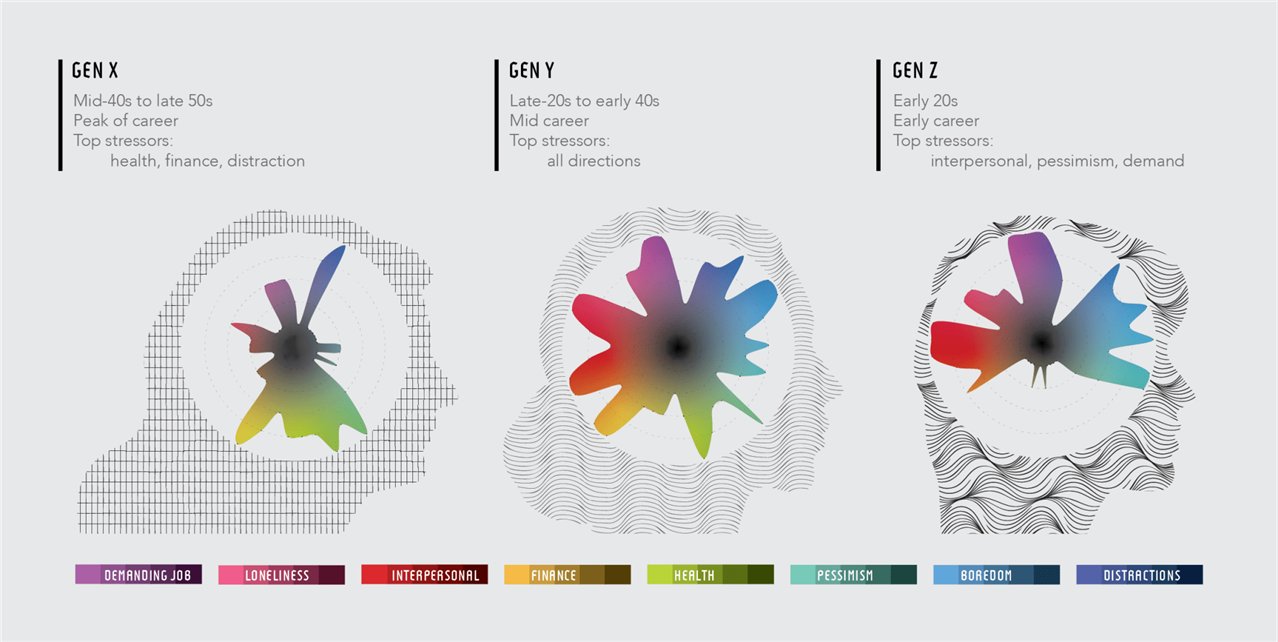
I was reading this week’s “Nightingale” – Data Visualisation Society eNewsletter (named after Florence, Nurse-Statistician-Legend) and there was an interesting article breaking down the 2024 State of the Global Workplace report by Gallup. The report was arguing that people’s mental well-being has deteriorated in the past ten years (I’m finally trendy! Yay!).
However, in her article “the XYZ of Work-Related Stress”, author Shanfan Huang, makes a great point that different generations have different expectations of mental health as a priority at work. They also have a different framework around reporting and talking about workplace mental health. Overall, the trend could be quite good as it suggests that there could be a stronger conversation on mental health challenges and firmer boundaries. We also need to take into account that different generations have differing priorities for a number of reasons.
It’s worth having a look at and poking around the Nightingale site, if not for tips and “horror stories” then definitely for the beautiful Information is Beautiful award that the DVS is famous for!
(This piece of writing was created by my incredible friend Shelly and myself for our Neurodiversity and Wellness, Arts and Culture community that we chair)
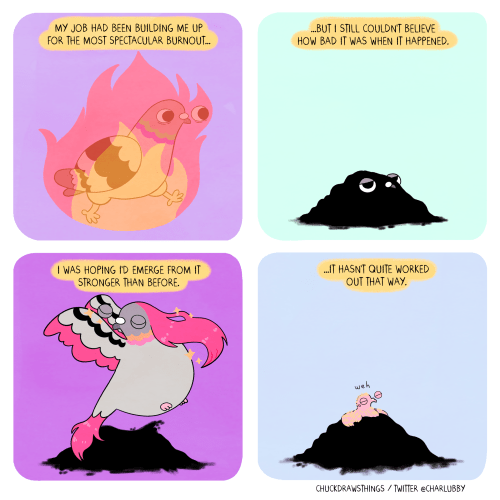
You might hear the term “Burnout” talked about a lot and maybe you’ve felt that way yourself.
But what is burnout?
How does burnout differ between different communities?
And what can you do about it for your co-workers, friends and yourself?
Defining Burnout
The World Health Organisation (WHO) points out that whilst burn-out is included in the 11th Revision of the International Classification of Diseases (ICD-11) as an occupational phenomenon, it is not classified as a medical condition.[1]
Burn-out is defined in ICD-11 as:
“a syndrome conceptualised as resulting from chronic workplace stress that has not been successfully managed. It is characterised by three dimensions:
• feelings of energy depletion or exhaustion; • increased mental distance from one’s job, or feelings of negativism or cynicism related to one’s job; and • reduced professional efficacy.”
WORLD HEALTH ORGANIZATION (MAY, 2019)
However, as the boundaries between work and home have blurred throughout the covid years, the occupational distinction has also become less fitting. Evidence shows that burnout makes no distinction between paid or unpaid work and people undertaking unpaid home or care duties can also be impacted[2].
The Black Dog Institute and the UNSW School of Psychiatry[2a] have carried out studies into factors that commonly concur with burnout, including:
Anxiety/stress
Depression and low mood
Irritability and anger
Sleep disturbances
Lack of motivation or passion
Lack of concentration, memory loss or brain fog
Withdrawal from others
Physical symptoms such as aches, headaches, nausea and low libido
Emotional fragility
It raises the chicken v egg question on whether these factors are a cause of or caused by burnout, or whether they are all a symptom of an underlying issue. The same researchers are also undertaking a followup study to further investigate the features of burnout and its relationship with depression.
Neurodivergent Burnout
In the neurodivergent communities, conversations about burnout are quite common. In fact many neurodivergent people come to uncover their uniqueness due to the burnout of trying to fly under the radar. The challenges of living and working in a society not designed for us can mean frequent overload that can push us into meltdown, shutdown, and burnout. Also life-changes can exacerbate challenges, for example transitioning from school to work, experiencing a mental health crisis, or the death of someone close[13]. Stigma can make prevention and recovery even harder.
So how does neurodivergent burnout differ from the WHO defined burnout?
A notable difference is in the causes of burnout [6]. Some of factors that lead to burnout for ND folk are:
Repeated sensory overload
Long term masking
Having social/sensory needs minimised by others due to appearing “fine” (i.e. “successful” masking)
Not having access to the appropriate level of supports & accommodations
Difficult or unreachable expectations from family, school, work, or society
Executive Functioning fatigue following a number of stressors or transitions
When the overall load exceeds abilities + supports = burnout
But impacts of burnout can also present differently, including [7]:
Loss of skills
Loss of interest in dedicated interest areas
Emotional regulation issues
Added anxiety and depression
A study by Dr Dora Rainmaker at Portland State University[11], involved interviews with autistic adults. Whilst her studies have been in the autistic population, the sentiment aligns with other neurodivergent communities. Findings included:
“… struggling with independent living, loss of self-belief, and being frightened that the loss of skills from the autistic burnout might be permanent.”
Dr. Dora Rainmaker
The results also pointed to a “lack of empathy from neurotypical people, who had difficulty understanding or relating to the autistic person’s experiences.”
What can we do about it?
Policy
On a policy level, it may be good to know that groups such as the Black Dog Institute are campaigning for workplace reform through methods such as their White Paper[9]. Actions your organisation can take include:
Evidence-based training for managers regarding the resources available and actions they can take to recognise and respond to mental health risk factors in the workplace.
Building mentally healthy workplaces.
Taking immediate action on bullying, sexual harassment and assault.
Self-care
The most important way to recover is prioritising self-care as a protective measure against burnout and other mental health issues. However self-care is often the first thing that gets sacrificed to work demands and stress.
So what is self care?
“Self-care refers to the activities and practices that we deliberately choose to engage in on a regular basis to maintain and enhance our health and wellbeing. Regular practices may include exercise, reading, meditation, disconnecting from technology, or talking with a friend or family member.”[10]
“When you take time for yourself to rest, reset, and rejuvenate you will actually have more energy to meet the demands of daily life as well as reduce or avoid the symptoms of mental ill-health.”
Dr Jan Orman
But what does Neurodivergent self-care look like?
For Neurodivergent folk there are a few ways to recover in addition (or instead of) neurotypical burnout recovery. In fact it’s worth noting that many neurotypical recovery techniques and interventions can be ineffective or even more overwhelming. Social support can add to overload, and even mindfulness may need a special touch as described by Sue Hutton[14].
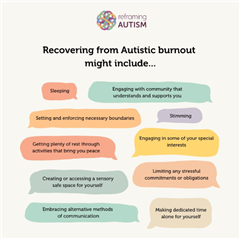
Neurodivergent affirming recovery methods can include [8, 11, 12]:
Deliberate reining back of tasks and responsibilities
Prioritising rest, recognising the necessity of healing, and equitable productivity
Careful unmasking where appropriate
Slow refocus on areas of interest and energy giving environments like nature
Outsource executive functioning tasks
Attending to sensory needs
Self-care Strategy
Prevention of burnout comes with increased awareness of needs and accommodation for those by workplaces, family and community. Clear boundaries and formal supports are also key to keeping the overload at bay.
The Black Dog institute has a comprehensive self care template designed so that you can craft a personal self-care strategy that works for you. It will guide you through the 4 steps of self-care planning:
If you are feeling burnout, run down or depression it’s worth talking to a mental health professional starting with your doctor. But if you are feeling that that’s a big first step try reaching out to the people around you and in your communities. Talking can help and it can make that journey more manageable by taking it one step at a time.
Go well!
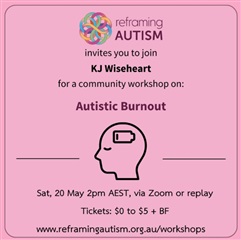
PS– what to learn more? Check out this upcoming workshop on Autistic Burnout:
This week I went to a wonderful accessible arts panel discussion on accessible tech in the arts. There are a lot of everyday uses of technology to use technology to increase the accessibility of arts and culture and our exceptional panel of Sophie Penkethman-Young (Australia Council), Marcus Wright (MCA), and Simon Buchanan (Sydney Opera House) unpacked a wide field of these. Technologies such as digital performance, alt text and captioning, digitally delivered workshops, Virtual narrators, Augmented Reality deepened experiences, and AI created audio description … yes Artificial Intelligence made it’s face known.
Lately, in so much of the conversation, Chat GTP, and the AI successors, has dominated the subject of technology and art. Whether it’s artists having their work used as a platform for training AI without their consent, to using AI to develop writing art and critique of writing and art.
But it’s in the most banal ways that AI could be an accommodative tool for those of us with disability. We may argue the merits and value of a novel or poem written by AI. But what about AI writing your grant proposal. On that artists seem to agree. Maybe not the whole thing, but for those of us struggling regularly with executive functioning dilemmas. Contrary to the narrative of procrastination and avoidance that saviours like to peddle, or the adjectives that beaten down neurodivergents find the selves reciting, some executive functioning issues come from the difficulty in engaging with an unmotivated task or from a difficulty in cracking the introductory social format that is often where we find our lives. Having and AI write a rough and inaccurate opening that you could take on for a spring board into self expression is a wonderful idea.
There are many technologies that we use and will arise to help us meet the goals of an inclusive society. But they really need to start with the opening up of society to be more inclusive. Having no meeting agenda or notetaking could be taken away by speech to text capture or AI inferred agenda in retrospect. But the thing that will get us to a harmonious society is not technology filling the gaps – it for there to be no gaps from the designing of the way we want our future society developing.
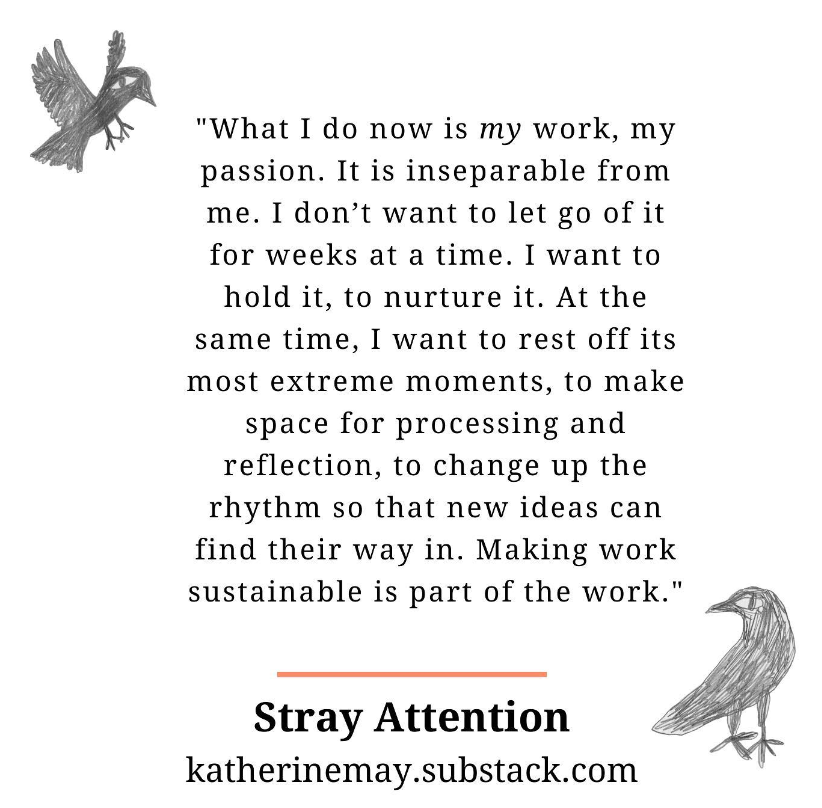
I came across Katherine May’s new blog post at 2 am on a Sunday trying to finish up work. As my life is more irony than substance these days I think it’s worth putting up.
It’s an important call to action. How do we make our work more sustainable? There are a couple of points in there for me
How do I automate manual tasks
How do I delegate with the goal of improving the work outcomes and career growth of others
How do I set up cross collaborations to distribute the load and remove bottle necks
How do we upskill for self-service and empowerment
Sustainability of work is easier to handle (and harder to refute) if it becomes about raising others up. Whilst I might be “essential” if I’m the sole knowledge holder I am also limiting my ability to take leave, adding risk to the risk matrix, and stopping others from understanding my needs. And sharing information can lead to great collaborations.
So perhaps there is something in that. Collaboration and advocacy can be used to create a healthy work structure.
One last thing though is the Black Dog Institutes self-care template. It’s a guide more than a prescribed set of marketing fluff, so common with these themes. You set the tasks that work for you at a rate you can take on. Well worth a look.
Settling into a new job, I was trying to explain the irreverent majesty that is Nerd Summer Camp1 to those of who have only seen it through rumour and the social media posts. Every time I try to explain TLCC to anyone I end up feeling like Judy Garland returning from Oz, and trying to convince her family that a magical place really exists.
From the emotional wave of ‘feels’ on social media, the dulcet tones of the Tessiturians (that majesty I was talking about), to the Campbellan journey of Jen Skelly’s lanyard2, it could seem pretty baffling. Even for those of us there it can be a lot to unpack.
On the way home I took some R&R in San Francisco while trying to wrangle my head and heart, like a parent collecting sugar fueled kids from a birthday party. With no small irony, I found some focus at a late night Jazz bar that serves (non-alcoholic) Kombucha cocktails. Yeah, I was that guy, minus the man-bun and ill advised facial hair.
Anyway I wrote some loosely SQL structured poetry over two nights, on a mini laptop at the bar (eating my vegan sliders). As I was in San Francisco (and had rewatched Mike Myers in “So I Married and Axe Murderer” again on the flight in), I went the full mile to gave it a spoken word recording. Given Andrew’s keynote unveiled his new love of great poetry I thought it’d be fun to share.
TLCC (In some ways)
In some ways, I’d forgotten what TLCC was like. Just how intense and overwhelming, joyful and exciting, frightening and sad.
The experience is something perhaps less like life, and better explained in Norse saga; breathed into existence by Walt Whitman; found in an attic as lost sketches for Picasso’s Guernica or Brett Whitley’s alchemy.
Feelings at TLCC seem taller, and broader. Like things that belong on the stage, poured from the musing of artists; not from the office that supports it3
And perhaps TLCC has answers to that as well. (the) Andrew Recinos quoted Lao Tsu in his closing address The wise have no minds of their own, finding it in the minds of ordinary people.4 And anyway, are there wise people at all?
Something that my friend,5 Mary French and I talked about,
when people say (sceptically or) in flattery, “Are you the smartest Tessitura person here?”
the answer is no … but also yes.
We are not the smartest,
except that we are, because we have the mind of the community behind us.
We are a gestalt;
An incredible hive mind of ordinary people, that do well on our own, but attain genius when we join together in odd harmonies.
And this becomes magnified, geometrically, in that liminal space of conference as our minds do not sum as single blocks, but create new 3rd and 4th opportunities between us that would never be possible apart.
We are more chemistry than physics.
With networking interactions happening at speed, and relationships (previously existing in green lines of commented SQL 6 or the brevity of forum assistance, between people at organisations, continents and hemispheres apart) are filled with both the details of real life, emotion of people who understand your most frustrating predicaments and greatest achievements.
In some ways, TLCC is like meeting your parallel earth doppelganger. That person with a similar experience; the same frustrations with “that” department; that has won “that” personal battle you’ve been fighting so long that you’ve lost the image of success;
and they can give you the key to success.
They are that person that also struggles to be seen 45+ hours a week, that validates all your experience.
They are your reflection, your potential energy, your soul.
So,
In some ways, It’s unsurprising that TLCC is such an emotional experience.
Spoken Word “In Some Ways”
[1] aka TLCC
[2] I’ve talked to my therapist extensively about the existential dread of wondering at the fate of Jen Skelly’s lanyard outside of the bubble that is pre-during-post conference that borders on the nature of quantum mechanics. Nietzsche said that we should live life as if the material world was all we could know, but if Jen Skelly’s lanyard only exists in the boundaries of a relative conference bubble, what is the fate of its existence post conference? Is there a post conference at all? Could all the lingering feels that we have post conference be the first evidence of quantum superposition in social media. Scary stuff.
[3] I really don’t agree. I see art everywhere. Art is in the person not the job. Like Jack (Rubin) said everyone is a little bit manager and a little bit leader in differing ratios. Punching out into the great blue yonder and mapping the path behind.
[4] not that I think Andrew is “ordinaryifying” Lao Tzu, at least that’s not his primary point. Regardless, I think that Lao Tzu who was aware of the conundrum first, and in essence, was setting himself up. I imagine he’s giggling at his clever joke still.
[5] and saviour and idol
[6] I had the pleasure of thanking Brian Wilbur Grundstrom for the number of times he appears in code comments in my database from stored procedures I’ve gleefully poached
So this is my last week at Sydney Dance Company and in rather than doing a big card and big gift we had individual cards and gave some money to a couple of animal sanctuaries that I really wanted to support.
The past 5+ years changed me immensly. When I started I definitely did not have qualifications of a unicorn. But the support from the incredible women who I’ve been lucky to call my bosses and mentors, and the unconditional love and support from my community at SDC and the #tessituranetwork has changed my life.
I will always be grateful for the opportunities to strive and push, grow and change. Opportunities to make small changes the in work life of colleagues with automations, or strategic inputs to the growth of the business be, it data driven decisions, silo removing technology, or EDI.
You learn a lot about your best self through goodbyes. Things that you overlook in your day to day struggles. I’m thankful for the inclusion and acceptance, never being patronised, compitence assumed. The lack of barrier between artists and admin at SDC proves that we are striving for the same goal
“We believe that dance changes you. To experience contemporary dance is to go on an inspiring and fulfilling journey. More than simply witnessing something beautiful or engaging with an art form, it is to be positively altered.”
Whether that’s through teaching dance to youth remotley during lockdown, choerographing exceptional works of beauty and relevance, or mentoring new DBAs that need support; we are working off the same playbook. To leave the world in a better place than when we found it.
Thank you for never treating me like I didn’t belong, thank you for giving me space to have a voice, thank you for allowing me to change and make change.
How to ADHD has really been on the money lately with incredible work tips that have really sung to me.
Taking on too much work.
Ah YES! Over committing is a huge challenge for my life for a number of reasons. Living a life in line with your values seemed a bit like the title of a pop psych book from the 90s (and personal baggage for another time). However stepping back for a minute and looking at what life values I need to prioritise was really great. Instead of fitting in one more request for other people, I really need to hit pause and take time out for myself, and the things on the top of my value list that I’m ignoring. Things like personal health and relationships.
One way that I’m looking at that at the moment is by monitoring my emotional health using the Daylio app. It also tracks potentially related stuff like healthy eating, exercise and personal timeouts. Because the best way to get an over committed data junkie to take time out is with the lure of more data.
The other thing is Trello. I talk about this a lot. I have a personal Kanban for projects that I need to achieve and hard and soft deadlines for that. For other work requests I’m building in two times a day of 30 minutes where I clear &/or prioritise those requests. Of course I can’t ignore everyone (as much as that sounds like heaven) but it does mean that I can block out times to focus and on what task knowing that the alerts will get dealt with in their own space.
Monotasking
That’s a great segue into the other great vlog – Monotasking. It’s a great reminder about the illusion that multitasking is somehow good. I’ve known for a long time that my brand autistic neurotype deals with interruptions by crashing my brains hard drive. It’s no secret that changing my focus requires a good 5-10 seconds to shelve what I was doing and making the turn. Even then it takes a bunch of effort to do. But split focus is also a pain for other neurotypes.
Monotasking is a great way to do lots well. Blocking out slabs of time to get things done. It’s also good to block in slabs of time to do social or answer people’s questions. It’s an idea I want to try out more and see how it goes.
Here are the two quick YouTube eps that I’m talking about. Love to hear the ways you are hacking your work for your brain.
I get the message. I don’t belong. I know that people would be upset to know that their words say that, but it’s there.
A work conversation recently to a group of colleagues was along the lines of, “it’s so much better for you to go into the office and have those organic conversations; to be able to catch someone in the corridor and get an answer to a question. We were all in yesterday and it was so easy and we got so much cleared.”
I know what they mean and I know that they mean well, but what they are actively telling me (and people like me) is that your authentic self is not welcome and your personal health is not important. ie: you don’t belong.
That’s a pretty strong statement for me to make. But it’s necessary because it’s in direct contravention of disability equity and inclusion goals. The act of having to prove fundamental truths about ones experience, and having to prove the barriers for disability is part of the problem. Milton’s double empathy problem1 states “when people with very different experiences of the world interact with one another, they will struggle to empathise with each other.” The issue is the lack of equality in the relationship creates a paradigm that, as the autistic experience is not able to be felt by others, it is frequently questioned, dismissed or disbelieved, despite evidence to the contrary.
Conversely we understand and accept the needs for a large portion of neurotypical & allistic society to need spontaneous interaction to function at their peak. If you need that to be at your best we support it (if it could not be at our expense that would be great too). Many of the needs of the widest part of the neurotypical (and frequently white, cis-male, heteronormative etc) community are baked into the work culture. But often that is at the expense of the minority.
Too many times in the past when I’ve come up against group pep talks (or group reprimand) I’ve approached the speaker to clarify what I’m doing wrong or explain the difficulty in doing what was asked. Every time I’ve been told “Oh I wasn’t talking to you”. What that DOES tell me is that I’m rarely, if ever, talked to. Like the opening speech. Hence my problem. What has been said in those moments are a general statement establishing general expectations, ie: the status quo. I exist outside of that ie: I am siloed.
“when people with very different experiences of the world interact with one another, they will struggle to empathise with each other.”
Damian E.M. Milton June 08 2012
So why is the office environment a problem?
Inherently it’s not, but a couple of issues are2:
Autistic folks keep a lot of information in conscious memory. On top of that we are asked to performatively mask in order to fit into the work culture taking up additional resources. Screening out background noise, smells and UV lighting takes even more resources. As a consequence there is not a lot of conscious processing left to focus on what we need to do. Therefore social interruptions and “can I just grab you a moment” can be crippling.
Masking leads to suicidality and burnout3. Reason being is that if you succeed then you have just proved that a persona is more valid than your authentic self. If you fail then you let slip your authentic self to your detriment. Additionally the effort to maintain that persona takes energy and focus that you need for your basic work and self.
Multiple conversations at the same time like in a lunch room, or corridor, require screening out of background noise and stimulus. That takes effort. That’s not even starting on eye contact and body language.
Not having time to prepare information for a conversation means that a lot of processing power will have to go into dragging that information into conscious memory, and shelving the task that you were on.
Often the spontaneous conversation will require an answer that hasn’t been scripted. Yet again this increases the amount of conscious thinking to
a) parse the information and formulate a response,
b) judge the position and personal status of the one you are talking to in case they need a specific tone or level of detail,
c) edit that response for generally socially acceptable norms,
d) keep looking for facial and/or body language cues from the person you are talking too. NB/ I have to do this in conscious memory.
We are expected to do all the above AND not rock the boat.
By existing outside of that I am excluded. So isn’t existing outside of the rules a positive accommodation? No. I’ll explain.
To fit into the work environment I’ll need to subject myself to exhaustion and pain OR not be in the room where decisions are being made. Not being in the place where the organic conversations were being had means being excluded from the decision making process (bad for me) and having ones knowledge, skill and experience removed from the decision (bad for the business).
Because I am rarely in the room when these decisions are being made I am frequently coming up against last minute deadlines. These scrambling for deadlines and approvals further impact mental health as well as business outcomes and can lead me to working 12+ hour days.
People don’t want to deal with disability and so they work around it and create a silo. This leads to more forceful insistence and begging, which in turn leads to more alienation.
So there’s got to be a solution right?
Sure, I’m not going to just complain and run (that’s no good for my own mental health at the very least). The solution is to be prepared. Set meetings with an agenda (or create them in the moment) and write stuff down. Designate someone to take minutes. Follow up and inform. Plan. Respect boundaries.
But there are other things as well. Celebrating team wins need to be done in a way that everyone can participate in. Staff x-mas parties are excluding, and if I attend I do so at my own health cost. Team building activities are the same.
So keep in mind that (despite what pop-organisational psychology might suggest) we are not all the same. You have a diversity of colleagues and reports. Treat them with equity (not just equality) and find the way to come together. They alternative is loss of talent and headaches – but also depression and burnout.
It’s a lovely sunny winter weekend afternoon over here in Sydney lockdown. I’ve just made a batch of spinach and cheese arancini and am contemplating the medium future in the way that you do when you are observing time by the rate that a cat has to shift its position on the bed to remain sleeping in the sun.
TLCC2021 stirred up a few thoughts for me. One was inspired from the many incredible sessions that I went to from the Tessitura Enterprise team (whom I always imagine as being Starfleet Officers). I succumbed to their insistence that I finally read CRM at the Speed of Light, and not leave it as a shelved trophy for my Zoom background.
The other was this blog post on the ADHD tax, that I’d been thinking about for some time. If you are not familiar there has been a term floating around the online community about the concept of this tax, the cost to ADHDers for replacing things that have gotten lost, credit score hits from forgetting bills, late fees for things that have not been returned on time, impulse buys for things that we honestly don’t need, etc. It is one of those things that ADHDers will sigh and agree, and a recent Reddit post with almost 9000 upvotes and 700 replies underscores that sentiment.
Back to reading Paul Greenberg, I was at around chapter 2 on collaborating with customers when those two thoughts crashed together. At TLCC I was banging on about making equity for neurodivergent folks in the workplace. This is incredibly important for belonging and inclusion for our colleagues. It is a simple step to widen that thought process to our ND customers.
I’m going to quote Starfleet’s quote of Paul Greenberg definition of CRM
“CRM is a philosophy and a business strategy supported by a system and a technology designed to improve human interactions in a business environment”
Paul Greenberg, CRM Magazine, October 2003
It’s that final bit that really is the kicker for me. In CRM at the Speed of Light 4th ed Paul goes on to define Social CRM as
“Social CRM is a philosophy and a business strategy, supported by a technology platform, business rules, processes, and social characteristics, designed to engage the customer in a collaborative conversation in order to provide mutually beneficial value in a trusted and transparent business environment.“
Paul Greenberg, CRM at the Speed of Light
The collaborative conversation in a trusted and transparent environment is important because, as we continue to see, we need to walk the values we talk.
So here is my pitch. In the interest of a modern and inclusive CRM (business and customer) relationship, how are arts orgs helping our customers with the ADHD tax? How are we helping patrons remember shows with pre show emails? How are we giving our customers clear and actionable ways of exchanging without judgement? What are our rules with regards to a cooling off period on impulse buys? A friend’s (Martin Keen) recent forum post on adding an iCal element to booking confirmations was a great thinking point on inclusive design and being broad in our DEAI goals.
There are a number of business rules, processes and technologies that we can use to engage our customers in ways that make our relationship stronger. I’m excited to look at my own organisation’s accessibility from increasingly broad perspectives.
Another conference over. Sad but true. It was about 50 hours of video and face to face over the week. As with conferences it was hyper focus for the week followed by info digestion time. Well meaning folk talk about looking after yourself, only doing x hours, regular breaks etc. and a lot of that is right. I would sleep in 1-3 hour shifts but my waking focus was all on conference learning and sharing. I’ve tried other ways of being but it’s not healthy to be honest. A little thing that allistics don’t really understand is that it’s not the hours that cause stress but the human interaction and switching between tasks that really get us. Suffice to say that it was a great conference with a lot achieved.
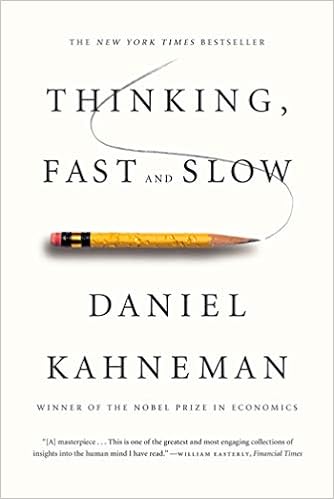
As always I went to quite a few Customer Relationship Management lectures and picked up a great suite of recommends – some that I’ve been wanting to read for a long time like “Nudge” (Thaler and Sunstein), “Decisive” (Chip and Dan Heath), “CRM at the Speed of Light” (Paul Greenberg) … and the huge favourite “Thinking Fast and Slow” by Nobel prize-winner Daniel Kahneman.
So I started by post conference reading on Daniel Kahneman. This book has come up in many conversations and readings over the years and is built on 40 years of research. Systems processing in psychology breaks thinking into 2 processes
System 1 “is the brain’s fast, automatic, intuitive approach”. System 1 activity includes the innate mental activities that we are born with, such as a preparedness to perceive the world around us, recognise objects, orient attention, avoid losses – and fear spiders! Other mental activities become fast and automatic through prolonged practice.
Of course I’ve come across intuition and heuristics before. I was a psych major and spent untold hours as an acting student at university in Sandy Meisner “magic circles” acting impulsively. These things were either ideological (the former) or a bit of a pretence (the latter). I was always told that I was too ‘much in my head’ as an actor and not impulsive and ‘gut’ enough. I got better at faking it OR rehearsing so much at home that the thinking became unrecognisably fast, like remembering lines by reading them off the script in my mind. I’d argue that people were just ignorant of the calculations that they were doing in social situations and the amount of relationship math that was going on to interact with others were just the thing that they liked to call “intuition.”
Then I discovered I was autistic.
Well it was a long time coming to be honest. I was many times called autistic or aspie (amongst other things) when I was overloaded enough that the mask dropped. I rolled with it and tried harder. and harder. and … well it got to a point when I was working with others a lot more than usual in strategy and inter-team negotiation. And when my boundaries were crossed one to many times I did what comes naturally – I researched – and discovered my autistic self. Meeting more and more autists I realised that I was not just hard work, a broken person, or less – but a fully functioning autistic adult. That’s a conversation for another time.
Back to “Thinking Fast and Slow” by Daniel Kahneman I was reading about word association games and impulsive thinking and exactly how (neurotypicals) think about these things. Having thoughts that just into their mind when another is said as if by magic. You see this doesn’t happen for me. When word associating with my wife and she says yoghurt I think hard and come up with the yogurt that I just put into the fridge and make a conscious choice that I’d go with blue like the navy blue sticker that was on the carton. Or if she said smile I would conjure the list of emoticons and go to the next one in the list as a conscious choice. Impulsive thoughts to me are just cognition at speed.
I’ve posited this to my autistic psychologist friends and looking forward to what they have to say. From the recent feedback they seem to agree. We don’t do System 1 thinking. We don’t attribute malice to a big triangle that is following a smaller one (you neurotypicals are weird), we think about it and respond ‘appropriately’ (I realise this is laughingly subjective). It’s the same reason I believe that we autists have a large disregard for gender stereotypes with our high gender queer constituency and a high sense of justice in our shirking of nonsensical social convention. Of course I’m massively biased but I know that because I don’t do System 1 thinking. I think that we do an incredible processing job emulating heuristic thinking and doing so wonderfully well. But I’m sure that my thoughts on this will evolve when I talk to our incredible community further who will enlighten me more.





 Heath Wilder